Showing posts with label aerial flyer. Show all posts

Tuesday, October 7, 2014

Ships of the Line

Swift Class Aerial Monitor (200 tons)
click image to download a PDF version.
The Swift gunboats are an experimental attempt to increase safety for British shipping in the Oenotrian border regions, especially near the foothills of the Shistomik Mountain range. While it bears a resemblance to the slightly smaller Aphid class, it learns from the lessons taught by previous Martian experience. It has the same armor, allowing it to ignore the effects of the smaller Martian cloudship guns, but in addition, it also armors all its guns, including its complement of four Nordenfelts. This was done to protect the relatively small crew complement from damage that the ship would otherwise ignore. Aphids have a poor reputation for crew safety, sometimes limping home in good condition, but with decimated crews, the open gun mounts making them easy prey to hostile fire. The Swift also uses the new forced draught steam engines, which allow it sufficient speed to evade almost all ramming attempts, as well as being able to pursue and overtake all known vessels in the colonies. Three Hale rocket batteries provide short range firepower, and the 3" HRC's, while small, have a high rate of fire, and are sufficient to wreak havoc on the poorly protected Martian vessels which the Swift was designed to combat.
Critics of the Swift complain that it does not have enough long range weaponry, and its altitude limitations render it vulnerable to attacks by the Martian Fire so common on larger vessels. Also, since it has only one Marine observer, it is especially vulnerable to being boarded. These criticisms are largely ignored at this point, since it is not designed to assault the crag keeps of the High Martians, and its batteries of Nordenfelts should be sufficient to discourage all but the most suicidal of boarding parties. Also, if this should become a problem, the Hale batteries can be easily dismounted, which would provide sufficient room for a temporary complement of six more Marines, quite enough for a vessel of this size.
Impenetrable Class Aerial Monitor (1000 tons)
click image to download a PDF version.
The Impenetrable is largest vessel currently under construction at the Syrtis Major shipyards. While not the largest vessel in Martian use, she will be the most heavily armored. In fact, the armor plating of the hull is too complex for the limited facilities on Mars, and the vessel is being shipped piece by piece from Birmingham, and assembled on site. As expected, this is a very costly undertaking, and the Foreign Office has drawn considerable fire from the liberal press for this "escalation of warlike tendencies" and "waste of money". The official rationale for the Impenetrable is that a vessel impervious to Martian weapons will prove the futility of native resistance, and once and for all stop the insurrections and piracy on British shipping that are now a major problem. Indeed, only the heaviest of Martian weapons can penetrate the hide of this vessel, while her complement of weapons is sufficient to destroy many Martian vessels in a single broadside. While not the awesome guns of water-bound ironclads, they are able to penetrate the armor of any foreign naval vessel currently in use. It is exactly these qualities which makes it such a destabilizing influence. Many fear that a vessel impenetrable by Martian weapons will drive the rebellious factions into the arms of some other nation which can supply them with heavier weapons, leading eventually to all-out warfare.
Critics of the design note its lack of heavy armament, altitude restrictions, and small complement of marines, all necessary sacrifices to achieve the extraordinary level of armor on the vessel. To its credit, it has a normal 20 day steaming range, a highly respectable top speed, and sufficient staying power to survive battles against more heavily armed opponents.
On the current construction schedule, observers note that it will be approximately 18 months before the Impenetrable can be launched, not counting delays due to public sentiment, economics, or potential problems with demagnetizing such a large mass of metal to avoid premature liftwood deterioration.
Swiftwing Courier (83 tons) - Screw galley
click image to download a PDF version.
Oenotrian factions battling the British are hampered not only by the tenacity of the Colonial army, but also by the age and tradition of their race. Unable or unwilling to change to more modern technologies, they require vastly superior numbers in any sort of military engagement, and still take frightful losses on occasion. However, not all Martians are hidebound by the ancient traditions, and some very few are learning lessons from colonial forces. Some of the first signs of this are shown in the Swiftwing, a ship built solely for high speed transport of cargo or important persons. Some seventy-five percent of the vessel is taken up with slave turncranks, giving the Swiftwing an extraordinary burst speed of 25 knots. This is also partially due to improvements in their airscrews, the design appearing a direct copy of the latest British vessels. The sole armament of the Swiftwing is a stern mounted sweeper, although up to 5 marines or an important personage and their bodyguards can also be carried.
Swiftwings are currently being used as scouts and transports, and sightings have preceded attacks on at least two occasions. While not quite as fast as some British vessels, superior knowledge of terrain and local sympathy have allowed almost all Swiftwings to escape capture by colonial forces. The only one that has been captured so far was also equipped with facilities for mounting a mast and sails, a feature which would greatly extend its cruising range and long-term speed, but expert analysis indicates that the extra weight of rigging would mandate a reduction of the extra crew, removal of the stern gun, or a sacrifice of maximum altitude.
Cleansing Wind (400 tons) - Screw galley
click image to download a PDF version.
The Cleansing Wind is another disturbing development of cloudship design, showing that more and more, new ideas are gaining acceptance in the traditional quarters of the Martian military. Others claim it is a sign of covert foreign support, but cooler heads say it seems unlikely the Oenotrian forces are desperate enough to join one set of "Red Devils" to repel another. The expert opinion at this time is that the design is an independent pirate vessel, but there is no proof one way or the other. Both the name and the style of this new ship have caused concern in diplomatic and military circles, although as yet, only one example has been seen.
The Cleansing Wind has almost abandoned the traditional screw galley design and armament in favor of a more modern outlook, and at range can be mistaken for a British vessel. Whether this is by design, or just simple plagiarism has yet to be determined. It does not mount any of the heavy rod or lob guns usually found on the larger screw galleys, and is not equipped with that most traditional of Martian weapons, the ram. Instead, it mounts three heavy guns, two lights and four sweepers, along with a single rack of the deadly Martian Fire. All these weapons are effective against the lighter of Her Majesty's ships, and especially so against civilian shipping. For a Martian vessel, it is singularly well armed, in quantity if not quality, and with a top speed measured at 20 knots, able to maintain distance from most heavy vessels, and close with the relatively slow merchants it may encounter. The size of the vessel is also disturbing. It is not a large vessel in Martian terms, and is seems very likely it was designed to accompany larger vessels or operate with large groups of similar sized ships.
The only sighting of this vessel to date was from H.M.S. Bellerophon, an Aphid class gunboat operating out of Srytis Major. The Cleansing Wind was encountered on a routine patrol, and refused to heave to. After an inconclusive engagement, both vessels turned and delivered point-blank broadsides. Bellerophon, crippled by a magazine explosion, made it home only by jettisoning her coal reserves, while the Cleansing Wind was unable to pursue due to heavy screw damage. However, it was seen to leave the area under its own power before Bellerophon disappeared from sight, and is presumed to be fully repaired by this time.
Scenario - Surprise Encounter
HMS Warrior, a Swift class monitor, was engaged in towing home HMS Firefly, an Aphid class gunboat which had been damaged in a scuffle in the Shistomik lowlands, when they encountered two Oenotrian vessels searching for prey. In hostile territory, with one crippled vessel, Her Majesty's ships decide to flee to friendly territory rather than get into a protracted engagement.
The Martian vessels, surprised by the appearance of the British vessels, nonetheless seized the opportunity, and attempted to cripple or destroy the Red Devils without taking any losses themselves.
Setup - Martians get the Cleansing Wind and a Small Bird screw galley, which they set up anywhere in the three hexes between the crags on the mountain map. One vessel is allowed per hex, and both must be facing along that row of hexes. Cleansing Wind has Canal Martian marines, armed with muskets. Initial altitude is High.
British start with the Warrior, and an Aphid class gunboat. Warrior starts in the hex with "1889" in it, facing NW, and Firefly is in the hex immediately behind it. Initial altitude is Medium. Firefly may start the game towed, in which case the vessels move at speed 4, or may be cut loose, in which case they move separately. The tow line may be cut at the start of any British movement, but the Firefly does not get to move at all on that turn.
Special Rules - Firefly has been damaged. The 1 pound HRC and Nordenfelt on the starboard side have been destroyed, and their crews killed. Mark them off. In addition, she is missing one deck crew, one engine crew, and three hull boxes. Due to engine damage, Firefly can only move intermittently. Each turn, right before British movement, roll 1d6. This is the number of MP the Firefly has for that turn. Initially, Warrior may assign some of her crew complement to Firefly, in which case these crew are subtracted from those on the Warrior. If either ship is forced to lose altitude due to damage, the stress will immediately sever the tow line, leaving Firefly immobilized for a turn.
Victory Conditions - Martians get 2 VP for each British ship destroyed or grounded, and 1 VP for each ship de-crewed or de-weaponed. British get 2 VP for each Martian ship destroyed or grounded, and 1 VP for each ship de-crewed or de-weaponed. In addition, the British get 1 VP per ship for exiting Warrior or Firefly off any edge of the NW map quadrant at an average speed greater than any Martian pursuit, at the instant the ship leaves the map. The base average speed of the Firefly is 3.5MP.
Optional Rule - Ballast dumping. British ships may, in an emergency, dump 90% of their coal reserves through chutes in the bottom of the hull. This reduces their cruising range to six strategic hexes, but lightens the ship enough to offset liftwood loss, temporarily erasing the last row of hull damage. This is announced at the start of movement, occurs during combat, and takes effect at the start of the next movement. It is only done when a crash is the inevitable result of severe damage. It also acts as an anti-personnel weapon, doing 1d6-3 "P" hits to anyone beneath the deluge of fist-sized coals, with additional minuses to the roll based on range, as per Martian Fire rules, and +1 per 2 hull sizes (round down) of the jettisoning vessel. Martian screw galleys can do much the same, jettisoning food, water, and dead turncrank slaves, but only get half (round up) a row of hull boxes, and their range is reduced to 4 hexes. This does not do damage to vessels below them. Kites may jettison cargo, gaining half a row of hull boxes for each twenty percent of their loaded mass they discard. Martian jettisoning requires at least one crew per 2 hull sizes to jettison the extra weight in one turn. Otherwise, it takes proportionately longer (round up).
Strategy - Both sides are hampered by altitude limits, and the rocky crags hamper visibility as well as movement. Of the numerous Martian guns, only the heavy and rogue guns can hurt the Warrior, while the Aphid is also vulnerable to these, and especially vulnerable to antipersonnel weapons with her reduced crew. However, the Cleansing Wind should not present her bow to either British ship at any time. Although all three heavy guns can fire into the bow arc, they are the only guns that can do so, and any gun hits will always take out a big gun. The Small Bird is capable of inflicting heavy damage with its rogue gun, and this should be used on the Firefly first, at close range. Already damaged, three hits of any type are likely to be crippling.
The best British course is probably to split up. While in theory, the average speed of Firefly is reduced, the average fleet maneuverability is increased, and Warrior can now take full advantage of her top speed. With starboard guns damaged, the Firefly's best broadside potential is only realized if a course is charted due north, skirting the crags and then going west, while Warrior, with its superior speed, is best served by going west, then north. All in all, the north-then-west option allows a fast exit, while still being able to take advantage of crag cover. The high rate of fire of all the Warrior's guns and rockets is murderous on both the unarmored Martian vessels, but the temptation to deliver a point-blank broadside should be tempered with the knowledge that one good roll from the Martian Fire can utterly destroy either British ship. The British can do a sacrifice play by destroying the Small Bird, and then exiting the Warrior (leaving the Aphid to its fate), but this is a marginal victory, and not very sporting. Likewise, the Martians can destroy the Firefly, and then attempt to exit the map for a victory, but would likely be pursued unless the Warrior was immobilized.

by Greg Porter, ©1991. This article originally appeared in issues #7 and #8 of The Game Oracle. It is used here with the permission of the author.


Sunday, August 31, 2014

Surprise at Clearwater

Red Captain Ronald Whitfield is a source of constant irritation to the Oenotrian Empire.
Ever since Ronald Whitfield first became a Red Captain, he and his kite, the Cloud Leopard, has been a source of constant irritation to the merchants of the Oenotrian Empire. To date, the Cloud Leopard has captured a dozen prizes, all Oenotrian, and caused great damage to the sky fleets of the empire. As well, Whitfield's old first mate, Andrew Phillips, soon became a Red Captain in his own right, commanding the Sky Lynx, a small screw galley refitted with a steam engine. By working together, the two Red Captains have been able to defeat more dangerous opponents than ever before.
Before the arrival of the humans on Mars, Martian culture had reached a point of stagnation in which innovation had nearly died out. In the years before the onset of this stagnation, Martian engineers developed a number of interesting and innovative weapons, which have never entered common usage for one reason or another. Two of these items are listed below.
Thunderbolt Quick-firing Light Gun
The thunderbolt is a variation on the theme of Earth's 15th century Veuglaire, which uses a removable firing chamber. This removable canister allows the Thunderbolt to have a longer barrel than standard light guns, since the weapon need not be muzzle-loaded. The canister is held in place by one or more wedges in primitive models. After firing, the crew loosens and removes the expended cartridge, replaces it with a loaded one, and tightens it in place.
This means of loading raises the gun's rate of fire somewhat, although three gunners are required to crew the weapon. The canister must be loaded with powder and shot in conventional fashion, but a number can be prepared ahead of time, at leisure, ensuring a better measured charge than is possible in the heat of battle. The increased rate of fire is achieved at a loss of range, however, because the seal at the breach is usually poor (due to corrosive effects of Martian gunpowder), and considerable pressure is lost, with consequent reduction in range. Despite this, Thunderbolts are still popular with some captains.
Thunderbolt Table
Weapon Wt Pen Dv ROF Crew Rng Cost
Thunderbolt 30 0 1 2 3 1/2 600
click image to download the PDF ship chart
Lob Gun Incendiary Projectile
The incendiary round for lob guns is a projectile that combines some of the impact damage of the normal lob gun round with the incendiary traits of Martian liquid fire. In form, the incendiary round consists of approximately a dozen small, stone containers of Martian liquid fire, banded together with iron to form a projectile nearly the same size as a normal lob gun round. The containers are scored to make them fracture upon impact, even with a wooden-hulled ship. The round is loaded into a lob gun in the same manner as a normal lob gun round. When the projectile is fired, one of the stone containers sometimes fractures in flight, which gives the round the appearance of a fireball as it flies through the air. The remaining containers burst and spill liquid fire when the round strikes its target. The fire level suffered by the target is determined by rolling 1D6 and subtracting the range in hexes from the gun to its target.
The incendiary round also causes impact damage: A lob gun firing such a round is considered to have a penetration of 1 and a damage value of 3 (rather than the standard values of Pen 2 and DV 4). As well, there is some chance of a loss of trim critical being caused by an incendiary round, but because of the projectile's lighter weight, that chance is not so great as with a normal round. When an incendiary round hits a target from a lob gun, roll 1D6: on a roll of 1-3, a loss of trim critical occurs.
Because of the difficulty involved in constructing incendiary projectiles for lob guns, each round is considered to have a cost of £5. Players should be careful to keep track of exactly how many incendiary rounds a ship carries. If a hit occurs on a lob gun magazine containing incendiary projectiles, roll 1D6 for each such projectile to determine the level of fire that breaks out on the ship.
The Oenotrian Empire responded to this increased threat by stepping up efforts to locate and destroy the Cloud Leopard and its companion vessel. With great numbers of Oenotrian warships searching for them, Whitfield and Phillips recently headed north to prey upon High Martian pirates until the ire of the Oenotrians had cooled a bit. Unfortunately for the two Red Captains, a number of Oenotrian warships pursued them all the way to the Meroe Badlands.
A few days before the beginning of the scenario, the Cloud Leopard and the Sky Lynx stumbled upon a pair of Sky Runner class vessels. The Red Captains heavily damaged the two ships, but in the fighting, the Sky Lynx took a boiler hit, and the Sky Runners were able to escape.
Most of the drinking water on both Red Captains' ships went to replace that lost from the Sky Lynx's boiler. With the crews on short water rations, Whitfield and Phillips decided to set a course for the city of Mylarkt to replenish water and pick up other supplies.
While heading for Mylarkt, however, the Red Captains discovered an abandoned High Martian kraag and stopped to explore it. Upon entering the kraag, they found a spring at its bottom. With the Cloud Leopard keeping watch overhead, the Sky Lynx set down and replenished its water supply. Then, the two ships switched places, and the Sky Lynx kept watch. While the Cloud Leopard was thus occupied, a violent sandstorm swept through the region. Unable to climb above the turbulence, the Sky Lynx was forced to set down as well. Once the storm passed, the two vessels prepared to get under way, but a trio of Oenotrian warships had followed close on the heels of the storm. Spotting the two ships on the ground, the Oenotrians closed in for the kill. At this point the scenario begins.
The Red Captains' Vessels
The Cloud Leopard is simply a Swiftwood-class kite that has been refitted with British weaponry. The Sky Lynx was originally built in a Martian yard, but was later refitted with a British steam engine and weapons.
The Cloud Leopard has Crack crews on its four-inch long gun and the spar-mounted six-pounders. Its other gun crews are Trained. The Sky Lynx has Crack crews on all of its guns. Marines on both vessels have modern rifles and are Trained.
Both ships have a number of smoke screens and spike droppers, as indicated in their respective ship record forms.
The Oenotrian Vessels
The three Life's Ends in this scenario are new designs, not encountered by the Red Captains before. One of these vessels is equipped with Thunderbolts and has exchanged its forward heavy gun for a rouge gun.
Each of the three ships has one Crack, two Trained, and one Green gun crew (to be distributed, as the Martian player desires). The marines on all three ships carry muskets and are Trained.
Setup
Ship record forms for all ships in this scenario are included with this article, as is a map of the terrain over which the battle takes place. To play this scenario, you will need to reproduce this map on a two-inch hex grid (if this is not practical, the Kraag Barovaar map from Sky Galleons of Mars may be substituted in which case the starting points will have to be changed). The Cloud Leopard begins at Low altitude at point 4. The Sky Lynx begins on the surface (one step below Very Low altitude) at point 5.
Martian 1 begins at point 1, at Medium to High altitude. Martians number 2 and 3 enter the map at points 2 and 3 respectively, during the Martian player's movement phase of the second game turn. They also begin at Medium to High altitude.
Victory Conditions
The Oenotrians get 1 victory point for driving the Sky Lynx from the map, 2 points for destroying the vessel and 4 points for capturing it. They get 2 victory points for driving the Cloud Leopard away, 3 points for destroying it, and 6 points for capturing it.
The Red Captains get no points for driving an Oenotrian vessel off the map, but they get 1 point for each ship they destroy and 2 points of each one they capture.
Model Conversions
You can easily make specific models for the ships in this scenario using the standard Sky Galleons of Mars sprues.
Extra sprues of these ships were available from GDW in the packages of Martian Cloudships and Aerial Gunboats.
To make a Life's End, simply replace the forecastle of a large screw galley model with the forecastle of a small kite model, then carve or sand off the lob gun mount.
The Sky Lynx can be built from the hull of a small kite and the tail of an Aphid. Remove the fore gun from the kite and glue the tail of the Aphid in its place to create a quarterdeck. Finally, fill in the mast hole and sand it smooth.
The Cloud Leopard is built as if it were a Swiftwood, following the instructions included with Martian Cloudships. Paint the ships to your individual taste, and enjoy the game.

by Bret Foland and Lester W. Smith, ©1990; the article originally appeared in Challenge, #40 & #41, GDW's magazine of science fiction gaming. It is used here with the permission of Mr. Smith.


Tuesday, August 19, 2014

HMS Viper

The HMS Viper is a conversion of a typical Oenotrian Small Bird class screw galley, after her captured and return to Syrtis Major as a prize. The Viper received a re-fit in the British yard there. During the refit, the Royal Navy's yardmaster added a small surplus boiler, replacing the turn crank and flywheel, and updated the weapons compliment with modern ordinance, including a 1 pounder pom pom gun in a bow tower mount.

Technical Specifications 
click image to download a PDF copy of the chart.

Armor: 0
Hull: 2
Speed: 3
Altitude: High
Tonnage:
Price:
Crew: 3 + 3 + 22
 Bridge: C,H,T,S,O
 Deck: 2
 Maneuver: 2
 Gunners: 9
 Marines: 1 + 9
Armament:
 3 9pdr (aft)
 2 1pdr HRC (bow)
 1 1pdr pom-pom (bow tower)
 1 tether mine

Scenario

After receiving her commissioning pennant, the Viper's first action was defending a British convoy from an Oenotrian raider:

June, 1889

Lt Cdr Mitchell's first priority is to make sure that the merchant vessels he is escorting successfully reach the city of Haatt. However, he has been schooled in the Royal Navy tradition of Nelson, and the opportunity to engage the enemy can not be passed upon.

In a high risk, high reward scenario, Mitchell decides to risk splitting his convoy and engaging the Oenotrian's on his own, knowing that should he fail to stop the Oenotrian the convoy maybe lost.

Setup

Use either board, ignoring terrain, the encounter takes place over the dry sea bed between Syrtis Major and Haatt.

The Oenotrian enters from the Northeast corner of the board. The British enter from the Southwest corner of the board.  The convoy is off the south edge of the board.

Oenotrian Squadron

1 Endtime (screw galley)

British Squadron

1 HMS Viper (converted Small Bird screw galley)

Game Length

10 turns

Special Rules

The HMS Viper is undermanned and has no marines aboard (they planned to pick up the Marines in Haatt).

Victory Conditions

The British must capture, destroy, drive off, disable, or otherwise prevent the Oenotrian from exiting the Southern edge of the game board.  If the British ship is captured, disabled, or destroyed the Oenotrian player automatically wins.


The stats for the HMS Viper and scenario details are ©2014 by Joseph Boeke, and based on Matthew V. Jessick's battle report: A Naval Report


Tuesday, August 5, 2014

New Ships for Space: 1889

A good game is one that you can play and enjoy. A great game is one that you can still enjoy years later. We have always considered GDW's Space: 1889 to be part of the later category. It is elegant from a design standpoint; a naval miniatures game, and a land-combat miniatures game all seamlessly interfaced and without an overbearing amount of rules.

Described herein are two ships that were developed for my own miniatures games. We encourage you to use them yourself, and to develop your own designs as well. Nothing enriches a game of this nature more than the combined efforts of those who enjoy it.

FLAME EAGLE SCREW GALLEY
Download a PDF version of this chart

The Flame Eagle is a conversion of the Skyfire hull, which emerged shortly after the first Skyfire, was launched. It retains the heavier Rouge and Rod guns in the aft section, but replaces the midship Heavy guns and Tether Mines with Martian Fire droppers. There is known to be at least one in service with the Oenotrian Empire at this point.

The primary purpose of this vessel is to do battle with European armored ships. Oenotrian generals, frustrated by the ineffectiveness of their smoothbore cannon against armored European hulls, have abandoned older design models in favor of a ship that carries Martian liquid fire as its main weapon. The result is fearsome. While Martian Fire is awkward to use, a Flame Eagle, which managed to maneuver itself into position, could utterly destroy an undamaged British Triumph-class by releasing only half its payload. Neither to be ignored is its ram, which is backed up by enough momentum to send even the largest ships reeling out of the sky.

The Flame Eagle's low top speed was the subject of heated debates among the Imperial Oenotrian Construction Corps as this ship and its sister-class, the Skyfire, were in conception. One camp held that any ship that was to hold its own against the Europeans must have a protected hull, to keep the turncranks from being raked by machine-guns and repeating machine-cannon. The other side contended that the extra weight of a protected hull made the ship too slow to catch the European vessels, so that it would be pounded to flinders by the enemy's long guns without ever closing to do battle. The truth of the matter remains yet to be seen.

LUFTZEPPELIN KARL VON ZEUG

The Karl Von Zeug was one of Germany's first interplanetary warships. Constructed during the colonization of Venus, it was frequently used to cow the natives into submission, raking villages and war parties with no less than eight 1" Gattling machine cannon. Its six-inch gun was included as a defense against other European warships.

In 1887 the Von Zeug was relegated to the status of Armed Transport due to its small size and low interplanetary speed, which are no longer competitive with the ether warships of other nations. It has also been criticized by German commanders for its lack of a turret. Its low maneuverability, combined with the limited arc of fire of its main gun, leaves it vulnerable to being outmaneuvered and destroyed by atmospheric flyers. At present its only duties are the ferrying of valuable cargo between Germany and Venus, as well as occasional patrols through aboriginal lands of the Venusians.


Download a PDF version of this chart

About the Author

Vince Blackburn is a government attorney in California who grew up on the island of Kodiak in Alaska. He began gaming when he was seven years old with the original "Blue Box" Dungeons and Dragons set, and has been hooked ever since. Today he plays a variety of tabletop and computer games with friends at his home in the suburbs of Sacramento, and spends the rest of his free time with his wife Lisa and an extremely spoiled house-cat.


This article originally appeared in issue 13 of Competitive Edge, One Small Step's former adult gaming magazine, ©1997. It used here with the permission of Mr. Blackburn.


Friday, July 25, 2014

Meeting Over the Column

November, 1889


A squadron of Oenotrian screw galleys was dispatched to raid a convoy of merchant cloudships supplying the Western Column of the British Martian Army. The convoy's British steam-powered escort was known to have retired to Avenel for coaling. The warships were spotted and identified by scouts on the ground while still 30 miles south west of the column. A call for help was heliographed back along the British line of march. The convoy was warned and began to make its way heavily back to the North as the Oenotrians churned on to the kill.

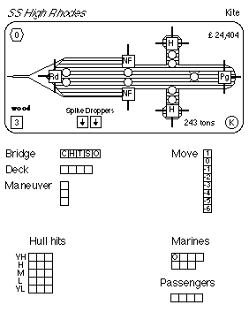
SS High Rhodes

The High Rhodes is a small privateer operating on Mars, which was one of the centers of Space Vermin's Space: 1889 campaign. The hull of the ship is a highly modified Swiftwood class Oenotrian kite (she was repaired and auctioned as a prize vessel). The kite was selected because:
  • they are, generally, faster than a crank vessel if one needs to run away.
  • it is much cheaper to operate and requires a smaller maneuver crew (even if one buys marshie slaves as crankers, you still need to feed them, wot?) - additionally, slaves won't fight for you, and freemen need to be paid...
  • steam vessels are quite rare on Mars, since the boilers and engines must be shipped from Earth, which makes them triply expensive outside governmental circles.
  • there is no need to waste cargo or supply space for coal.
This same rarity works against the availability of modern equipment and artillery available to British subjects (although American arms merchants make this less of a problem).
During the ship's outfitting, the captain was able to obtain a Letter of Marque, and used his contacts in the Royal Navy to obtain two 5-barrell Nordenfelts (replacing the sweepers) for the High Rhodes.
SS Rhodes chart
click image for a PDF of the chart

The nearest available help was a Royal Syrtan kite squadron and a British auxiliary (privateer). The Syrtan squadron flew south swift as the wind, arriving briefly before the Oenotrians could close with the convoy.

Oenotrian Squadron
3 Hullcutter screw-galleys
1 Clearsight screw-galley

Syrtan Squadron (British ally)
2 Whisperdeath kites
1 Bloodrunner kite
1 SS High Rhodes

Syrtan (British) Marines armed with rifles.
Oenotrian Marines armed with rifled muskets.
All crews are Trained.

Set up

Use either board, ignoring terrain. The encounter takes place over the flat desert west of the canal. Wind is from the north.

The Oenotrians enter from the southwest corner of the board. The Syrtans enter from the eastern half of the north edge of the board. The convoy is off the northeast edge of the board.

Option: For a smaller number of players, delete the Bloodrunner kite and the Clearsight galley.

Game Length

12 turns

Victory Conditions

Ships may exit off any edge, but once exited, they may not return to the battle. Oenotrians exiting to the northeast are attacking the convoy.

Oenotrians:
  • 10 points for every Whisperdeath kite destroyed.
  • 20 points for every Whisperdeath kite captured.
  • 10 points for every Hullcutter exited within 3 hexes of the northeast corner able to reach medium altitude (these can raid the supply convoy).
Syrtans (British):
  • 10 points for every Hullcutter destroyed.
  • 15 points for every Hullcutter captured.
  • 5 points for every Hullcutter exited south or west edges of the board.
Total the Victory points. High score wins.

Notes on the Royal Syrtan Navy


When the British Government established a Regency over Syrtis Major and its possessions in 1882, it needed an aerial navy. While it eventually began to build its own units, and in 1889 has few enough of those, it needed to start somewhere and even today needs units to fill gaps in its patrol areas. The navies of Syrtis Major and its allied cities were added into a combined service, the Royal Syrtan Navy. They fly a Syrtan pennant, with a quadrant showing the banner for the city the vessel originated in and a quadrant showing a Martian version of the Union Jack.
S.S. Rhodes
The Swiftwood-class kite S.S. Rhodes

The native vessels are under native commanders with native crews, though usually an English officer serves as mate or observer. The native vessels are slowly being replaced by British steel vessels, but the replacement process is slow - and the British cannot quickly replace the native Martian's expertise and knowledge of the local areas.

The continued native service provides natives with an honorable way to end their service to the Syrtan native crown, and eases tensions about British dominance, providing a point of pride for the native population. Compared to British aerial vessels, the Syrtan Navy is poorly funded and given few modern weapons, but its requirements are lower and additional funding is provided by the city governments as a point of pride and through merchants, usually as mild baksheesh.


Scenario and ship stats courtesy of Mitchell K. Schwartz ©1996


Monday, July 14, 2014

USS Eagle, Revised

USS Eagle on patrol over the coast.
The aerial rocket sloop USS Eagle is an unusual class of vessel, easily recognizable by its large outrigger-like racks of rocket batteries. Normally a small vessel of this type would be unable to accommodate more than a quarter of the rockets carried on the Eagle, but the ingenious design (and a 50% inflation of the vessel's basic cost) enables it to carry an intimidating ordinance load.

The principal disadvantage of the design is the likelihood that an explosion will set off a chain reaction of detonating rocket batteries.

Technical Specifications
Armor: 2
USS Eagle ship chart
click image for a PDF version
Hull: 4
Speed: 6
Engine: 6
Tonnage: 400
Cost: 67,410 pounds
Endurance: 10 days
Armament:
2x 3lb (fore and aft)
2x 6lbHRC (front left and right)
4x 1" Gatlings 2 each side
2&#160 bomb racks with 1 reload each
12 downward firing hales batteries
4&#160 upward firing hales batteries
Crew:
Captain, Helmsman, Trimsman, Signalman, Extra Officer
5 deckhands (1 is petty officer)
4 engineers
10 gunners
20 marines
Note: the above stats are reworked from the GDW original to correct any mistakes in the design rules and use up any spare space.

The Hale's Rocket Battery hit rules have also been re-written to actually increase the likelihood of the Eagle's experimental nature to cause a catastrophic break-up, and/or give it a chance to survive, during a pitched battle.

Determine any gun/mag hit location on the Eagle as follows:

Magazine Critical Hits:
Hit Location
Firing
Aspect
Die
Roll
Hit Location
forward/
stern
1: port boom
2-5: hull
6: starboard boom
broadside 1-2: nearest boom
3-6: hull

If Eagle-class ship takes a magazine critical hit on a boom battery there is a 1-2 on 1d6 chance that an adjacent battery will go up:
  • Include diagonal batteries as adjacent.
  • All adjacent batteries that go up, will roll again for surviving batteries. 
  • Hull batteries and batteries on the opposite boom do not count as adjacent.
Roll for damage effects as normal i.e. roll 1d6 for number of hits and then resolve damage for each hit. Resolve damage as follows:
  • Hull hits caused by these magazine explosions ignore the armor.
  • Gun hits cause a hull hit instead.
  • Critical and crew hits are resolved normally.
After all damage is calculated if the hull damage is greater than 4 the boom is considered to have blown off. The effect of losing a boom is:

There is an immediate trim critical hit, resolved as one roll with a damage level equal to the number of batteries that fired off.

If the Eagle survives that the her speed is halved for the rest of the game, all future trim critical hits will be treated as double the damage and all remaining rocket batteries on the boom will be lost.

This revision of the Eagle's stats is courtesy of Thomas C. Harris, ©1994.


©1995-2014 Paleotechnic Press . All rights reserved.