Showing posts with label Space 1889. Show all posts

Thursday, August 6, 2026

Martian Cities Schematic Map

Mars Schematic Map

One of the many projects I started and stopped work on over the past decade was an interactive map of the Martian cities. A map that shows distances which allows a GM to estimate how long a trip will take. A zoomable map covering every city, canal, and junction connected by the full network of established canal and caravan routes, with a built-in route distance calculator that reports a real travel distance between any two locations you specify. The result is this schematic map. Feel free to bookmark it, it's the kind of thing I hope you'll want to come back to next time you're planning a route.

Why this map needed to exist in the first place

This whole thing started because of a practical problem. I needed to know how far it really was from Syrtis Major to Melas, in the Belgian-controlled Coprates region, so I could calculate how long a canal or caravan trip between them would take, for an adventure scenario.

That sounds like a five-minute question. It wasn't. I tried working it out from Conklin's Atlas of the Worlds first, and it turned out to be genuinely difficult. The large-scale published maps of Mars are perfect for getting a feel for the Space: 1889 setting, but they're not built for pulling a real mileage figure off of them. At that scale, the gap between "a few days' journey" and "a multi-week expedition" can come down to a couple of centimeters of map, measured by eye, with no reliable way to convert that gap into an actual distance. And that's before you even account for the fact that a flat map distorts distance depending on where on the globe you're looking. I kept taking rough ruler measurements that didn't agree with each other, and I couldn't tell if that was my measuring or the map itself lying to me.

The place to start was Dan Thompson's merged map, the one that stitches Mars's three separately-published face-maps into a single continuous reference (used here with his permission, and with real thanks to him for it, since none of this happens without that head start). Even with that in hand, my first approach was just holding a ruler up to a printed copy. That led to the idea of overlaying a coordinate grid instead of eyeballing it. That led to realizing Photoshop would handle the grid better than graph paper would. And that led to the actual idea behind this whole tool: record real X/Y coordinates for every city and canal, and use them to build something closer to a subway map, one that could report a real distance between any two points instead of just showing a pretty picture of the terrain.

So this map and its Route Distance Calculator exist to answer that kind of question properly. Name two locations and get back a real, trustworthy distance, grounded in actual spherical geometry instead of a guess pulled off a fold in a poster map. Syrtis Major to Belgian Coprates, without traveling through Oenotrian territory, was the very first route it was ever asked to solve. Of course, the players decided to take a "shortcut" through the desert, off the established canal and caravan routes, and this map handled that too (although not necessarily the encounters they'd find along that uncharted route).

Here's how it actually pulls that off.

Every flat map of a round world tells a small lie

You can't peel an orange and lay the peel flat on a table without it tearing, stretching, or bunching up somewhere. The same is true of any map of a planet. There's no way to flatten a curved surface without distorting something: distance, area, shape, or direction. Every map projection ever made picks which one to sacrifice.

This Mars map uses a projection called Mercator, the same style Gerardus Mercator invented in 1569 for European sailors. Mercator's genius was realizing that if you're steering a ship, the one thing you can't afford to distort is direction. A straight line on the map needs to match a constant compass heading in real life. To pull that off, Mercator projections sacrifice distance instead. They stretch the map more and more as you move away from the equator, so regions near the poles end up looking much bigger on the page than they really are. It's the reason Greenland looks the size of Africa on old classroom wall maps, when in reality Africa is about 14 times larger.

The distortion is exact, not random

Here's the part that matters for our purposes. Mercator's stretching isn't a fudge or an approximation. It follows a precise mathematical rule tied directly to latitude. That means the distortion can be measured exactly at any point on the map, and if you can measure a distortion exactly, you can undo it exactly.

That's what happens behind the scenes here. Every city's X/Y position on the flat map corresponds to one specific true latitude and longitude on the Martian globe, the same kind of coordinates you'd use to pinpoint a city on Earth. When the map calculates a distance, it doesn't just measure a ruler-straight line between two dots on your screen. It first translates both points back into their real latitude and longitude, then calculates the distance the way navigators and airline route-planners have for centuries: as a great-circle distance, the shortest path between two points measured along the curve of the sphere, not across a flat page.

A simple way to picture it: imagine Mars as an actual globe sitting on your desk, and you stretch a piece of string taut between two pinholes marking two cities. The string wants to lie along the globe's curve, not cut straight through the inside of the planet. That string's length is what our calculator is measuring, not the distance between the two dots as they happen to appear on your flat screen. Two cities that look widely separated on the flat map, especially near the poles, can turn out to be considerably closer together in real terms than that flat-map gap suggests.

Why this actually matters, with real numbers

This isn't a minor technicality. If you simply measured distances with a ruler on the flat, uncorrected map, you'd overestimate the true distance by about 14% on average. For city pairs at high latitudes, where Mercator's stretching is most severe, the flat-map measurement can run as much as 62% longer than the real spherical distance.

Take Dioscuria and Aryn, two real cities connected by an established caravan route. Dioscuria sits well north of the equator. Aryn sits almost right on it. Measure the gap between them on the flat map using a single uniform scale, and you'd call it about 1,939 miles. The actual spherical distance is 1,732 miles, so the flat reading overstates the trip by 12%. Nothing about the caravan route itself changed. The correction is purely in how the two points' positions get translated back into real latitude and longitude before the distance is measured along the globe rather than across the page.

The effect shows up just as clearly in a tight cluster of cities as it does over a long haul. The Boreosytris League (Meroe, Coloe, Umbra, and Saardaar) sits far enough north that the four cities are more tightly packed in reality than the map lets on. Add up the four established canal legs connecting them (Coloe to Meroe, Meroe to Umbra, Umbra to Saardaar, Saardaar to Coloe), and the true spherical distance comes to about 327 miles total. Read those same four legs off the flat map with a uniform scale, and you'd get roughly 498 miles. Every leg is overstated by 49 to 56%, because all four cities sit at nearly the same high latitude and get stretched by almost exactly the same amount. The League is a noticeably more compact, easy-to-defend cluster of cities than a glance at the map might suggest.

The upshot

Every mile shown on this map, whether you're reading a single route's length or adding up a multi-leg caravan journey in the Route Distance Calculator, is a real, spherically-corrected distance, calibrated against Mars's actual equatorial circumference. The flat map is just the display. The geography underneath it gets treated as the sphere it actually is.

Some notes about the map itself. I have attempted to eliminate any of the anomalies introduced in the original Conklin's maps. In particular, a few cities have different names on different faces (so I have chosen one name for consistency) and where one face showed a canal or caravan route that was missing on a connecting face, I opted to be inclusive. Finally, I made the assumption that the ruins indicated on the Conklin's maps were located along the paths of the ancient canals, rather than out in the Martian deserts. If you find something that I may have missed, please feel free to drop me a note or leave a comment here and I'll do my best to rectify the map.

Happy gaming!


Tuesday, August 4, 2026

Bennet Burleigh (1840-1914)


Bennet Burleigh
BURLEIGH IS the Syrtis Major correspondent for the Daily Telegraph, a leading London daily, posted to Mars just as his paper once posted him wherever the Empire went to war. Scottish-born, he fled to America as a young man, fought for the Confederacy, was captured, escaped, and rode with a raiding party against Union shipping on the Great Lakes before the law finally caught up with him and sent him home in disgrace. He remade himself as a journalist and spent the better part of a decade following British arms through Egypt and the Sudan. He watched the campaign of '82 unfold from the canal works outside Ismailia, and three years later he was attached to the Desert Column on the Nile when Burnaby flew Gordon out of a besieged Khartoum by aerial launch, an escape that saved one man's life but neither the city's nor the column's. He does not consider himself a sentimental man, but he has watched enough relief efforts arrive after the fact to recognize the shape of the problem before anyone else in the room does.
Burleigh files fast, files first, and is not above petty sabotage to keep a rival correspondent's dispatch off the wire behind his own. He has no patience for Colonial Office caution and even less for a good story spoiled by a cautious editor, but he is scrupulously accurate about facts he can verify himself, having learned the hard way that a correspondent's whole worth is his word.
Reporter (Veteran NPC)

Att.
Skills
Str:
3
Fisticuffs: 2, Throwing: 1, Close Combat 2 (edged weapons)
Agl:
3
Stealth: 2, Marksmanship: 2 (pistol)
End:
5
Wilderness Travel: 4 (desert), Fieldcraft 3, Tracking 1
Int:
5
Observation: 5, Science: 1 (geography)
Chr:
4
Eloquence: 5, Linguistics 3 (Arabic, French, Spanish), Theatrics 3, Bargaining 3
Soc:
3
Riding: 3 (horse), Piloting: 1 (aerial flyers)
Motives: Ambitious, Adventuresome, Ruthless
The correspondent on a battlefield.
Appearance: Burleigh is a stocky, weathered man in his late forties, thick through the shoulders from decades of campaign living, with a heavy mustache gone mostly grey and a Glasgow burr that thickens when he is angry or excited. His hands are permanently ink-stained, and he carries a battered dispatch case everywhere, along with a revolver he has owned since his American days and has no intention of surrendering to peacetime habits. His campaign clothes are practical rather than fashionable, patched more than once, and he shows no self-consciousness about it in company that would notice. He has a habit of watching a room's exits before he watches the people in it, a leftover instinct from a young manhood spent one step ahead of Federal patrols. When he smells a story, he becomes suddenly, disarmingly charming, a quality that has gotten him into headquarters tents closed to every other correspondent on three worlds.

Background: Prior careers include soldier of fortune and journalist. Bennet Burleigh is 49 years old and is from the middle class


Tuesday, October 21, 2014

Heros von Borcke (1835–1895)

Heros von Borcke, in Germany, after the American Civil War.
Johann August Heinrich Heros von Borcke is known as the "giant in gray." Born to an aristocratic German family, he spent his childhood in Berlin and Halle before receiving a Prussian military education. Von Borcke was commissioned an ensign in 1853 and admitted to the Cuirassier Regiment of Guards as a cadet. He was then posted as second lieutenant to the Second Brandenburg Regiment of Dragoons in 1860. After obtaining a leave from the Prussian Army, he embarked upon the adventure of his life; sailing for Bermuda, intent on joining the Confederate Army during the American Civil War.
Speaking almost no English, von Borcke managed to secure letters of introduction to Confederate authorities, and slipped into South Carolina's Charleston Harbor via a blockade runner on May 24, 1862. He next traveled to Richmond, where he met with Confederate Secretary of War George Randolph, who presented him with a letter of introduction to Major General J.E.B. Stuart.
A deep friendship developed immediately between the two men, and von Borcke was made a captain in the Provisional Army of the Confederate States and later promoted to the rank of major. Von Borcke could be entertaining and told wonderful stories with his thick accent. His horses were as big as his extra-long sword, a beast of a blade forged in Solingen of Damascus steel. He rode with Stuart, who affectionately called him "Von," during the Northern Virginia and Maryland campaigns, acquiring a reputation for bravery. He served with Stuart in the Battle of Middleburg on June 19, 1863, where he suffered a severe wound. The examining doctor somberly declared the wound, which pierced the lung, mortal -- but von Borcke woke up the next morning determined to live, and he did. Placed on limited duty for the remainder of the year, he resumed his position on Stuart's staff in the spring of 1864. Heros was present at the Battle of Yellow Tavern, where J.E.B. Stuart was mortally wounded, and von Borcke sat at Stuart's deathbed, holding his hand, and promised to see after Stuart's widow and children. Von Borcke was promoted to lieutenant colonel in December of 1864, was voted the official thanks of the Confederate Congress, and sent on a diplomatic mission to England by President Jefferson Davis.
While in London, he wrote articles for the pro-Confederate Blackwood's Edinburgh Magazine. The articles were later collected and published in book form as Memoirs of the Confederate War for IndependenceWhen the Confederacy collapsed in 1865, von Borcke returned to his native Prussia and resumed his military career. He fought in the 1866 Austro-Prussian War, receiving the coveted Order of the Red Eagle for his gallantry, but his old wounds continued to plague him, so he retired from the Prussian Army as Captain in 1867.
Von Borcke had three sons with his first wife, Magdalene Honig. When Magdalene passed away in 1883, he married her sister, and they had a daughter named Karoline Virginia -- named in honor of his adopted, and beloved, southern state back in America.
Even after the war, von Borcke's maintained a deep affection and respect for the Confederacy. So much so that unsuspecting visitors to East Prussia are often surprised to see the Confederate flag flying (next to the Prussian flag) from the battlements of von Borcke's ancestral estate in Geisenbrugge, Pomerania. In 1884, he returned to the United States for a reunion with many former friends and comrades, and presented his famous Damascus sword to them. The sword was later given to the State of Virginia.
Von Borcke is an aristocrat of some means, with a bent for adventure, meaning he could be encountered nearly anywhere in the solar system -- wherever the German flag is flown. However, his poor health (the result of his Civil War wound) makes Mars' dry climate and lower gravity an attractive option. His sympathy for the Confederate cause means that he may also be encountered wherever a Confederate expatriate community exists.
Army (Veteran NPC)
Lieutenant-Colonel Heros von Borcke
Att.
Skills
Str:
4
Fisticuffs: 4, Throwing: 2, Close Combat: 4 (sword)
Agl:
3
Stealth: 2, Marksmanship: 2 (pistol)
End:
2
Wilderness Travel: 3
Int:
2
Observation: 1
Chr:
5
Eloquence: 5, Language: 1 (English)
Soc:
5
Riding: 5 (horse), Leadership: 2
Motives: Adventuresome, Arrogant, Eccentric
Appearance: With curly blond hair, laughing eyes, and an engaging personality, von Borcke has an imposing presence. By nineteenth-century standards, he is larger than life, standing six feet four inches in height and weighing in at well over two hundred forty pounds. His stature, personality, and social status make him popular among his peers. However, he can also be a bit vain and difficult to get along with at times, especially for his servants. Although he recovered from the wounds suffered in 1863, neither von Borcke's physical strength nor his endurance fully recovered (having been Str: 6, End: 4 as a young man).


Tuesday, August 5, 2014

New Ships for Space: 1889

A good game is one that you can play and enjoy. A great game is one that you can still enjoy years later. We have always considered GDW's Space: 1889 to be part of the later category. It is elegant from a design standpoint; a naval miniatures game, and a land-combat miniatures game all seamlessly interfaced and without an overbearing amount of rules.

Described herein are two ships that were developed for my own miniatures games. We encourage you to use them yourself, and to develop your own designs as well. Nothing enriches a game of this nature more than the combined efforts of those who enjoy it.

FLAME EAGLE SCREW GALLEY
Download a PDF version of this chart

The Flame Eagle is a conversion of the Skyfire hull, which emerged shortly after the first Skyfire, was launched. It retains the heavier Rouge and Rod guns in the aft section, but replaces the midship Heavy guns and Tether Mines with Martian Fire droppers. There is known to be at least one in service with the Oenotrian Empire at this point.

The primary purpose of this vessel is to do battle with European armored ships. Oenotrian generals, frustrated by the ineffectiveness of their smoothbore cannon against armored European hulls, have abandoned older design models in favor of a ship that carries Martian liquid fire as its main weapon. The result is fearsome. While Martian Fire is awkward to use, a Flame Eagle, which managed to maneuver itself into position, could utterly destroy an undamaged British Triumph-class by releasing only half its payload. Neither to be ignored is its ram, which is backed up by enough momentum to send even the largest ships reeling out of the sky.

The Flame Eagle's low top speed was the subject of heated debates among the Imperial Oenotrian Construction Corps as this ship and its sister-class, the Skyfire, were in conception. One camp held that any ship that was to hold its own against the Europeans must have a protected hull, to keep the turncranks from being raked by machine-guns and repeating machine-cannon. The other side contended that the extra weight of a protected hull made the ship too slow to catch the European vessels, so that it would be pounded to flinders by the enemy's long guns without ever closing to do battle. The truth of the matter remains yet to be seen.

LUFTZEPPELIN KARL VON ZEUG

The Karl Von Zeug was one of Germany's first interplanetary warships. Constructed during the colonization of Venus, it was frequently used to cow the natives into submission, raking villages and war parties with no less than eight 1" Gattling machine cannon. Its six-inch gun was included as a defense against other European warships.

In 1887 the Von Zeug was relegated to the status of Armed Transport due to its small size and low interplanetary speed, which are no longer competitive with the ether warships of other nations. It has also been criticized by German commanders for its lack of a turret. Its low maneuverability, combined with the limited arc of fire of its main gun, leaves it vulnerable to being outmaneuvered and destroyed by atmospheric flyers. At present its only duties are the ferrying of valuable cargo between Germany and Venus, as well as occasional patrols through aboriginal lands of the Venusians.


Download a PDF version of this chart

About the Author

Vince Blackburn is a government attorney in California who grew up on the island of Kodiak in Alaska. He began gaming when he was seven years old with the original "Blue Box" Dungeons and Dragons set, and has been hooked ever since. Today he plays a variety of tabletop and computer games with friends at his home in the suburbs of Sacramento, and spends the rest of his free time with his wife Lisa and an extremely spoiled house-cat.


This article originally appeared in issue 13 of Competitive Edge, One Small Step's former adult gaming magazine, ©1997. It used here with the permission of Mr. Blackburn.


Friday, July 25, 2014

Meeting Over the Column

November, 1889


A squadron of Oenotrian screw galleys was dispatched to raid a convoy of merchant cloudships supplying the Western Column of the British Martian Army. The convoy's British steam-powered escort was known to have retired to Avenel for coaling. The warships were spotted and identified by scouts on the ground while still 30 miles south west of the column. A call for help was heliographed back along the British line of march. The convoy was warned and began to make its way heavily back to the North as the Oenotrians churned on to the kill.

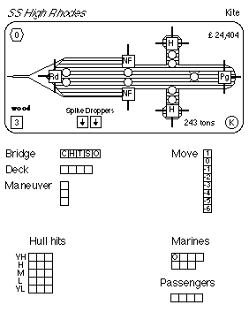
SS High Rhodes

The High Rhodes is a small privateer operating on Mars, which was one of the centers of Space Vermin's Space: 1889 campaign. The hull of the ship is a highly modified Swiftwood class Oenotrian kite (she was repaired and auctioned as a prize vessel). The kite was selected because:
  • they are, generally, faster than a crank vessel if one needs to run away.
  • it is much cheaper to operate and requires a smaller maneuver crew (even if one buys marshie slaves as crankers, you still need to feed them, wot?) - additionally, slaves won't fight for you, and freemen need to be paid...
  • steam vessels are quite rare on Mars, since the boilers and engines must be shipped from Earth, which makes them triply expensive outside governmental circles.
  • there is no need to waste cargo or supply space for coal.
This same rarity works against the availability of modern equipment and artillery available to British subjects (although American arms merchants make this less of a problem).
During the ship's outfitting, the captain was able to obtain a Letter of Marque, and used his contacts in the Royal Navy to obtain two 5-barrell Nordenfelts (replacing the sweepers) for the High Rhodes.
SS Rhodes chart
click image for a PDF of the chart

The nearest available help was a Royal Syrtan kite squadron and a British auxiliary (privateer). The Syrtan squadron flew south swift as the wind, arriving briefly before the Oenotrians could close with the convoy.

Oenotrian Squadron
3 Hullcutter screw-galleys
1 Clearsight screw-galley

Syrtan Squadron (British ally)
2 Whisperdeath kites
1 Bloodrunner kite
1 SS High Rhodes

Syrtan (British) Marines armed with rifles.
Oenotrian Marines armed with rifled muskets.
All crews are Trained.

Set up

Use either board, ignoring terrain. The encounter takes place over the flat desert west of the canal. Wind is from the north.

The Oenotrians enter from the southwest corner of the board. The Syrtans enter from the eastern half of the north edge of the board. The convoy is off the northeast edge of the board.

Option: For a smaller number of players, delete the Bloodrunner kite and the Clearsight galley.

Game Length

12 turns

Victory Conditions

Ships may exit off any edge, but once exited, they may not return to the battle. Oenotrians exiting to the northeast are attacking the convoy.

Oenotrians:
  • 10 points for every Whisperdeath kite destroyed.
  • 20 points for every Whisperdeath kite captured.
  • 10 points for every Hullcutter exited within 3 hexes of the northeast corner able to reach medium altitude (these can raid the supply convoy).
Syrtans (British):
  • 10 points for every Hullcutter destroyed.
  • 15 points for every Hullcutter captured.
  • 5 points for every Hullcutter exited south or west edges of the board.
Total the Victory points. High score wins.

Notes on the Royal Syrtan Navy


When the British Government established a Regency over Syrtis Major and its possessions in 1882, it needed an aerial navy. While it eventually began to build its own units, and in 1889 has few enough of those, it needed to start somewhere and even today needs units to fill gaps in its patrol areas. The navies of Syrtis Major and its allied cities were added into a combined service, the Royal Syrtan Navy. They fly a Syrtan pennant, with a quadrant showing the banner for the city the vessel originated in and a quadrant showing a Martian version of the Union Jack.
S.S. Rhodes
The Swiftwood-class kite S.S. Rhodes

The native vessels are under native commanders with native crews, though usually an English officer serves as mate or observer. The native vessels are slowly being replaced by British steel vessels, but the replacement process is slow - and the British cannot quickly replace the native Martian's expertise and knowledge of the local areas.

The continued native service provides natives with an honorable way to end their service to the Syrtan native crown, and eases tensions about British dominance, providing a point of pride for the native population. Compared to British aerial vessels, the Syrtan Navy is poorly funded and given few modern weapons, but its requirements are lower and additional funding is provided by the city governments as a point of pride and through merchants, usually as mild baksheesh.


Scenario and ship stats courtesy of Mitchell K. Schwartz ©1996


Saturday, July 19, 2014

Fuelless Flyers

Could new technology make the steam engine obsolete? In a scenario to 'GDW's Space 1889' our reporter investigates some daring new concepts in flyer design.

ONE of the major limiting factors in flight is the need for such heavy equipment as a power plant and coal bunkers, sails, or galley cranksmen. The fact that such mechanisms might one-day be discarded has received remarkably little attention.

One of Lilienthal's 19th C. gliders.
While liftwood can be used to build so-called perpetual motion machines (such as the Great Wheel of Garyaan, described in Canal Priests of Mars), they obtain their power from gravity and the interaction of liftwood with the ether, and must be firmly anchored to the ground. They are not suitable for use in an aerial conveyance. It should be obvious, however, that flyers themselves take advantage of this 'free' power whenever they ascend.

Recent experiments with winged heavier-than-air gliders have established that it is possible to build a craft capable of attaining respectable speeds by trading height for velocity. It may even be possible to take advantage of 'thermals' and other upwards air currents, familiar to anyone who has ever traveled by flyer, to regain height. Naturally, such craft must eventually land, but some remarkable results have been achieved, most notably by the late Sir George Caley and more recently by the German engineer Otto Lilienthal.
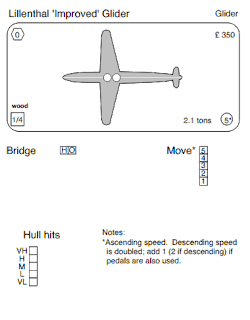
Lilienthal Glider chart
click image for a PDF of the chart

Level: 10 knots*
Powerplant: Liftwood-assisted glider with man powered airscrew.
Crew: 2 (pilot and observer)
Armament: none
Armor: none
Cost: £350
*Add 10 knots if the occupants are pedaling.

Liftwood panels would allow gliders to maintain their speed while gaining height, and thus stay aloft indefinitely. Headway would only be lost if the craft attempted to maintain constant altitude, and it might be possible to use a foot-pedaled airscrew for this eventuality. Such a craft would look radically different from our current flyers, much more like the winged aircraft envisioned by Da Vinci. It has the potential to be as fast as any steam flyer in service today.

It would be wrong to suggest that there are no drawbacks to this idea. A craft that must constantly change altitude might induce nausea in its passengers. The degree of such sickness would, of course, relate to the frequency of such altitude changes; it has seldom been reported by users of conventional gliders, who rarely experience anything other than a slow descent, and occasional broken limbs. More seriously, constant altitude changes and the need for extensive streamlining would make gliders a poor mount for artillery and other weapons, and it might cause stresses, which would limit their cargo capacity.

Putting these facts together, the most likely use for such a craft would be as a courier or as a fast, maneuverable and almost completely silent scout, possibly launched from a larger vessel, capable of carrying a helmsman (who also operates the trim controls) and one or two observers. The amount of liftwood built into the craft could be remarkably small compared too that needed for a normal flyer; once it is moving at any speed, air flowing over the wings should provide considerable upthrust. In flight the liftwood would mainly provide the extra impetus need to gain height after each descent, a relatively small amount of the force. Since the liftwood would not be the sole support of the craft, trim errors would be considerably less important than in a conventional flyer, giving the helmsman ample time to compensate before they become critical.

In the long term, it is possible to envisage a hybrid craft combinine the best features of the liftwood flyer and the glider, capable of high speeds and perhaps carrying several tons of cargo. But perhaps such wild speculation is best left to the writers of scientific romances and their readers…

About the Author

Marcus Rowland is a London based laboratory technician and the author of Canal Priests of Mars and other material for Space 1889. He has also written numerous other adventures and articles, as well as the role-playing game Forgotten Futures, a series on disk that is distributed as computer shareware.


by Marcus L. Rowland, ©1990. Fuelless Flyers originally appeared in a British game shop newsletter. It is used here with the permission of the author.


Otto Lilienthal (1848-1896)

Otto Lilienthal stamp
To invent an airplane is nothing. To build one is something. But to fly is everything. ~Otto Lilienthal
The noted aviation historian, Sir Charles Gibbs-Smith, divided flyer inventors into two categories. The first he termed "Chauffeurs of the Air," because "they act as though flying is like driving a carriage." Maxim is perhaps the best example of this large category. In contrast, Gibbs-Smith said that "Airmen" are those who understand that the fluid medium of air makes flight a quite different proposition than land/water-based maneuvering.
Gibbs-Smith continued that the chauffeur-type tends to be concerned with obtaining sufficient propulsion, without worrying overmuch about factors like lift or control. While the airmen often work on gliders before tackling the problem of powered, dynamic-lift flight. Of all of the aviation pioneers who fall into Gibbs-Smith's prototypical "Airman" category, the German Otto Lilienthal best exemplifies those characteristics.
Before 1881, attempts to develop dynamic-lift flyers were occasional and sporadic. Lilienthal changed all that. His efforts broke the 'respectability barrier' that haunted serious efforts to develop dynamic-lift flyers. During the late 1880s, Lilienthal developed eighteen different models of gliders. His efforts received worldwide publicity, and his successes lent others the courage to follow in his footsteps.
Perhaps Lilienthal's most influential work is his paper Practical Experiments for the Development of Human Flight. This seminal work continued to influence dynamic-lift research for years. Before Lilienthal, building a heavier-than-air, dynamic-lift craft was widely considered to be the province of dreamers and fools; after it seemed possible to fly without the aid of liftwood or hydrogen.
Scientist/Inventor (Green NPC)
Att.
Skills
Str:
2
Fisticuffs: 1, Throwing: 1
Agl:
3
Stealth: 2, Mechanics: 2 (machinist)
End:
2
Wilderness Travel: 1
Int:
6
Observation: 6, Science: 5 (physics), Engineering 3 (naval engineering)
Chr:
4
Eloquence: 3, Linguistics 2 (English)
Soc:
4
Riding: 3 (horse), Piloting: 2 (aerial flyers)
Motives: Driven, Knowledge, Loyal
Appearance: Lilienthal is a distinguished man, slightly above average in both build and looks. He is well-spoken and is able to persuade people to his point of view, due in large part to his intelligence and command of the subject matter. His primary language is German, but he speaks English as well. His passion is aeronautics, and in particular, that dynamic-lift flight models are superior to static-lift (hydrogen and liftwood) models. His research has been focused on replicating flight models based on the study of bird flight.


Monday, July 14, 2014

USS Eagle, Revised

USS Eagle on patrol over the coast.
The aerial rocket sloop USS Eagle is an unusual class of vessel, easily recognizable by its large outrigger-like racks of rocket batteries. Normally a small vessel of this type would be unable to accommodate more than a quarter of the rockets carried on the Eagle, but the ingenious design (and a 50% inflation of the vessel's basic cost) enables it to carry an intimidating ordinance load.

The principal disadvantage of the design is the likelihood that an explosion will set off a chain reaction of detonating rocket batteries.

Technical Specifications
Armor: 2
USS Eagle ship chart
click image for a PDF version
Hull: 4
Speed: 6
Engine: 6
Tonnage: 400
Cost: 67,410 pounds
Endurance: 10 days
Armament:
2x 3lb (fore and aft)
2x 6lbHRC (front left and right)
4x 1" Gatlings 2 each side
2&#160 bomb racks with 1 reload each
12 downward firing hales batteries
4&#160 upward firing hales batteries
Crew:
Captain, Helmsman, Trimsman, Signalman, Extra Officer
5 deckhands (1 is petty officer)
4 engineers
10 gunners
20 marines
Note: the above stats are reworked from the GDW original to correct any mistakes in the design rules and use up any spare space.

The Hale's Rocket Battery hit rules have also been re-written to actually increase the likelihood of the Eagle's experimental nature to cause a catastrophic break-up, and/or give it a chance to survive, during a pitched battle.

Determine any gun/mag hit location on the Eagle as follows:

Magazine Critical Hits:
Hit Location
Firing
Aspect
Die
Roll
Hit Location
forward/
stern
1: port boom
2-5: hull
6: starboard boom
broadside 1-2: nearest boom
3-6: hull

If Eagle-class ship takes a magazine critical hit on a boom battery there is a 1-2 on 1d6 chance that an adjacent battery will go up:
  • Include diagonal batteries as adjacent.
  • All adjacent batteries that go up, will roll again for surviving batteries. 
  • Hull batteries and batteries on the opposite boom do not count as adjacent.
Roll for damage effects as normal i.e. roll 1d6 for number of hits and then resolve damage for each hit. Resolve damage as follows:
  • Hull hits caused by these magazine explosions ignore the armor.
  • Gun hits cause a hull hit instead.
  • Critical and crew hits are resolved normally.
After all damage is calculated if the hull damage is greater than 4 the boom is considered to have blown off. The effect of losing a boom is:

There is an immediate trim critical hit, resolved as one roll with a damage level equal to the number of batteries that fired off.

If the Eagle survives that the her speed is halved for the rest of the game, all future trim critical hits will be treated as double the damage and all remaining rocket batteries on the boom will be lost.

This revision of the Eagle's stats is courtesy of Thomas C. Harris, ©1994.


Search This Blog

Translate

©1995-2026 Paleotechnic Press . All rights reserved.